comsc US Politics | AMERICAblog News: food
Join Email List | About us | AMERICAblog Gay
Elections | Economic Crisis | Jobs | TSA | Limbaugh | Fun Stuff

Showing posts with label food. Show all posts

Massive worldwide slaughter of farm animals to push food prices up 14% — a climate story


View Comments | Reddit | Tumblr | Digg | FARK
Via valued Twitter friend MiroCollas, we find this important story. Food prices are set to go markedly higher worldwide.

Raw Story and The Guardian:
Farmers who cannot afford feed ‘liquidating’ pig and cattle herds will drive food inflation to record high, says Rabobank report

The mass slaughter of millions of farm animals across the world is expected to push food prices to their highest ever levels. ...

Farmers across the world have begun a mass slaughter of their pig and cattle herds because they cannot afford the cost of feed, which has soared following the worst US drought in living memory, according to a report published on Wednesday.

Experts at investment bank Rabobank warn that the mass “herd liquidation” will contribute to a 14% jump in the price of the average basket of food by next summer. ...

US farmers, who are suffering from the worst drought since the 1930s, have already reduced their cattle herd to the smallest since 1973.
Of course there's an upside — for the .01%. Near the end we're told that "global food traders are expecting bumper profits."

But back to the cause, this is a climate story. Record droughts cause farmers to slaughter pig and cattle herds because of feed prices. Just like in the sea, if you kill off the plankton, you start losing whales.

Expect more of this, much more. We've got roughly .8°C (1½°F) warming now, and this is the result. There's double that in the pipeline, inevitable, can't be stopped. And that's if we end the carbon-dumping industry today. If we don't end carbon-dumping now, that "in the pipeline" number gets pushed ever higher.

(See here for my personal climate model.)

It's ironic the way the crisis feeds itself. The more we carbonate the air, the more we need air conditioning; thus more carbon burned.

The more we heat the air, the more we fry the fields, the less food we have for more people. Therefore we create more political chaos when what we need most is a considered, orderly solution.

It really comes down to one problem — The Carbon CEOs are determined to sell the last molecule they own, regardless of the price to the rest of us. Will we let them?

Of course, they always ask, "At what cost?" implying that somehow putting them out of business will be inconvenient for us.

This story is about the cost of not putting them out of business.

GP

To follow or send links: @Gaius_Publius
  Read the rest of this post...

Barclays bank made nearly $800 million speculating on food


View Comments | Reddit | Tumblr | Digg | FARK
When central bankers talk about more quantitative easing to help spur markets, remember this. While millions around the world go hungry or pay more for food, the bankers are cashing on enormously on the crisis. Barclays is being named here but don't forget that both Goldman Sachs and Morgan Stanley also operate in this space.

There used to be rules against profiting from items like food but that became old fashioned and required modernization by the political class. If they can't make a single case out of losing trillions of dollars during the banking crisis, it's obvious at this point that the political class won't be interested in reforming this revolting business.

How's that modernization working for everyone?
Oxfam's private sector adviser, Rob Nash, said: "The food market is becoming a playground for investors rather than a market place for farmers. The trend of big investors betting on food prices is transforming food into a financial asset while exacerbating the risk of price spikes that hit the poor hardest."

The World Development Movement report estimates that Barclays made as much as £529m from its "food speculative activities" in 2010 and 2011. Barclays made up to £340m from food speculation in 2010, as the prices of agricultural commodities such as corn, wheat and soya were rising. The following year, the bank made a smaller sum – of up to £189m – as prices fell, WDM said.

The revenues that Barclays and other banks make from trading in everything from wheat and corn to coffee and cocoa, are expected to increase this year, with prices once again on the rise. Corn prices have risen by 45 per cent since the start of June, with wheat jumping by 30 per cent.
Read the rest of this post...

Study: Quit smoking, exercise, and going out adds 5-6 years to life


View Comments | Reddit | Tumblr | Digg | FARK
Not that it's a surprise, but eating healthy food, exercising and having a social life is good for your health. BBC News:
They showed that smokers died a year earlier, but people who quit in middle age were almost as long-lived as those who had never smoked.

Swimming, walking and gymnastics increased life expectancy by around two years. People with a rich social circle lived a year and a half longer than those without.

Combining figures for healthy, low risk, lifestyles showed men could extend their lives by six years, and women by five years, by adopting the most healthy options.
I was always impressed with Jojo's French grandparents, who even into their 90's would take a walk every day. Both ate well, enjoyed having family over and led very actives lives. Genes surely had something to do with it, but it didn't hurt that they were disciplined at the table and kept active. Even after her grandmother had hip surgery in her late 80's, she was back walking within two months. Read the rest of this post...

Solving the climate crisis: How to paint the possible futures


View Comments | Reddit | Tumblr | Digg | FARK
UPDATE: A complete list of climate series pieces is available here:
The Climate series: a reference post.
________

[This post has been temporarily withdrawn for revision. Please check back later. Thanks.]


GP

To follow or send links: @Gaius_Publius
  Read the rest of this post...

Crops unharvested in California due to labor shortage


View Comments | Reddit | Tumblr | Digg | FARK
The problem of crops going unharvested raises a few questions that have been ignored during the anti-immigration debates. If the anti-immigration people are able to shut down the border, are they also willing to pay a lot more money for the produce due to higher wages being paid by the farms? If farmers are struggling to find workers during this economy, clearly they're not offering enough money for the hard work involved.

Are the farmers themselves ready to pay more money or are their margins already too low? Some are but even then, few want to do this back breaking work. Either way, it's a pity so see good food go to waste while crops are dying elsewhere in the US.
"This year is the worst it's been, ever," said Craig Underwood, who farms everything from strawberries to lemons to peppers, carrots, and turnips in Ventura County.

Some crops aren't get picked this season due to a lack of workers.

"We just left them in the field," he said.

The Western Growers Association told CNBC its members are reporting a 20 percent drop in laborers this year. Stronger border controls are keeping workers from crossing into the U.S. illegally, and the current guest worker program is not providing enough bodies.
Read the rest of this post...

Italians make edible coffee cup


View Comments | Reddit | Tumblr | Digg | FARK
God bless them.

Read the rest of this post...

The dinner party of the damned, or how not to throw a "dîner" in France


View Comments | Reddit | Tumblr | Digg | FARK
Preparations for the dinner party of the damned continue. I decided to invite some French friends for a greco-american dinner tonight, and, well, it's been challenging.

First there was translating french recipes into US units, and trying to guess what, say, 10 tablespoons of corn starch looks like by sight, or 2 cups of grated cheese, because we of course don't have those measuring devices in France, and finding the french equivalent of sour cream (I went for light creme fraiche at 15% fat), then realizing that the eggs are bigger here, so the recipes I'm making are turning out wetter.

Costco-sized cheesecake.
Then realizing that mom's cheesecake recipe, which is for an American spring form pan (8.5 inches diameter), is far too little for a French spring form pan (10.2 inches diameter), so I had to run out and get more cream cheese and could only find "light" (considering the guests don't know NY cheesecake, it's rare in france, I'm hoping they don't notice that there's a layer of light cheesecake on top of the full-fat cheesecake).

Sauteing the eggplant, bechamel
for the moussaka in the middle.
Then I go to make the moussaka, and of course, can't find a 9x13 pan, have to go much bigger, so double the recipe (which is great fun when you're pan sautéing a gazillion slices of eggplant (now times two) a few at a time). Surprisingly, the moussaka did not spill out of the pan all over the oven, as expected.

But I write too soon. After spending about 5 hours on the moussaka, the oven almost catches fire from the butter that dripped from the spring form pan when I was baking the cheesecake crust (because I probably used too much butter in the crust - why? - because there are no graham crackers here so I have to improvise with speculoos, a wonderful regional cookie (who knew you needed to put a spring form pan on another pan in case it drips?) Smoke is pouring out everywhere, I put the fan by the window to blow the smoke out, but of course the fan is oscillating, so it's only blowing out the window part-time (I got the fan last week, and quelle surprise, it was missing the part that stops the fan from oscillating - almost returned it, but then figured, when will I seriously need to stop the fan from oscillating?).

So, at 1030 at night, moussaka still unbaked, I wait for the oven to cool down, clean the butter from the inside, start the oven again, more smoke.  This time I crank the oven up to 250 celsius, 500 F give or take, and let it cook a while. Smoke goes away.  Moussaka is done by 1230am, let it cool a bit, throw it in the fridge warm (better than leaving it out to cool all night and risk poisoning the guests (a distinct possibility, the way things are going).

Oh, fun fact about some French ovens.  The temperature can only be set in 25 degree celsius increments, or about a 45 degree F increment - so there's no setting the oven to 325. It's either 300, 350 or 400.  Adjust cooking times accordingly, which is fun to calculate when you've doubled recipes that you have never doubled before.

Shut-off valve conveniently
hidden behind the wall.
Then this morning the toilet begins to leak like niagara, and who knew the cut off valve was in the cupboard, BEHIND a board in the wall? Run to the neighbor across the hall, not home. Run to the neighbors upstairs, no home.  Run downstairs, get the concierge, and frantically explain in utterly incorrect French: "It's urgent, the water is sticking to the toilet."

In my panic, I mixed up the French words "coller" (to stick) and "couler" (to flow). Couldn't help but think of David Sedaris, another neurotic gay Greek-American francophile, who once famously told his French landlord, "the toilet, she cry much of the time."


So I go to take a shower, drenching wet from sweat. And what do I discover? My good friend, Pierre the French mosquito, who's been camping out in the bedroom for the past month or so, decided last night to bite my nose four times. And like Chris, I for some reason have a reaction to European mosquitos (at least the ones in france and greece), where the bite looks like a rather huge pimple (actually a pimple would look smaller).

So that's the last 24 hours so far.

Dinner is tonight. Invited 8 people, me making 9, which of course is too many for this place, but oh well (France is all about making room for extra friends at the dinner table, which is something I very much like about this place). According to the weather, depending when you check, it's either going to pour or be a lovely 79 degrees. I'm counting on the former.

Finished moussaka.
Hopefully most of the possible shoes have dropped already, so tonight's dinner will go off without a hitch (still have to make the strawberry coulis for the cheesecake, mom's crab/artichoke dip, the strips of melon with prosciutto that Chris recommended, and the Greek peasant salad).

It's amazing how hard it is throwing a dinner party in a foreign country when you're a foreigner. It also doesn't help that folks here tend to (but not always) throw rather fancy dinner parties with lots of courses and far too much wine (I was told to plan on buying one bottle per person). I've decided to ditch the cheese course and serve the salad with the moussaka (it's good to push their horizons).

Wish me luck. Photos to follow.  Oh, and we may not have a ton of posts today, as Chris is on vacation and I'm clearly losing my mind.

PS Right on schedule, it's raining.

And it's sunny again.

Read the rest of this post...

The EPA was right, meat'll murder you


View Comments | Reddit | Tumblr | Digg | FARK
Not that I don't eat meat.  I love meat.  But with all the recent (and not so recent) news about how red meat can help lead you to an earlier death, I've been trying to cut back on it myself.  I like the idea of living longer.  Not so sold on the idea of dying earlier.

So, the Republicans flipped out at the USDA for urging its employees to celebrate Meatless Mondays.

I'm not surprised.  The GOP "is" all about special interests, and farming in America is one of the biggest special interests around.  So naturally, the Republican party would yet again find a way to help kill more Americans sooner.  Too bad we don't have a national system to guarantee good health insurance. Read the rest of this post...

New fake meat that apparently tastes really good


View Comments | Reddit | Tumblr | Digg | FARK
Slate has an interesting article about a new fake chicken, called Beyond Meat, that is so like real chicken it made a vegetarian a bit queasy.  I enjoy red meat, but know that it's not the healthiest thing on the planet (they say to have it only a few times a week max).  So I'm happy to try some of the fake stuff, but I haven't loved the stuff I've tried - it's either too salty, or too filled with garlic and other spices, or, like the chicken patties I was into for a while, too dry.  This stuff, apparently, is the real fake deal.  It's not available outside of Whole Foods in Northern CA, but I look forward to trying it. Read the rest of this post...

What is "climate catastrophe"?


View Comments | Reddit | Tumblr | Digg | FARK
UPDATE: A complete list of climate series pieces is available here:
The Climate series: a reference post.
________

This continues the Climate Catastrophe series I've been doing lately. Most recently, these have included:

  ■ Hugging the monster: Climate scientists and the C-word (Catastrophe)

  ■ The epic heat wave: "Of course it's about climate change"

  ■ Hansen on 3°C: Quarter to half of species on earth may die from global warming

I'll have a number of others — including a set of five that deal with Bill McKibben's recent (and must-read) article in Rolling Stone.

But before I continue, I want to look at the term I've been using as a substitute for the overly-polite "climate change" and its older cousin, the more accurate "global warming." My substitute — Climate Catastrophe.

What is "climate catastrophe"?

"Climate catastrophe" is not just a scare phrase, a metaphor. It's a description. Recently I quoted James Hansen in his paper "Perceptions of Climate Change: The New Climate Dice" (pdf):
If global warming approaches 3°C by the end of the century, it is estimated that 21-52% of the species on Earth will be committed to extinction.
That's Hansen writing, not me. Note that a rise in 3°C is about 6°F (actually 5.4°F). Not much. And as you'll soon read, we've already achieved .8°C of that 3°C — we're more than a quarter of the way there.

Now look at Hansen's estimated extinction rate — in round numbers, 20–50% of species gone for good. (That's a pretty wide range, by the way. As climate predictions go, we've been "exceeding expectations" lately, so I would anticipate the higher part of that range to be more likely, something like 30% or above.)

Here's what percentages of mass extinction look like over the history of life on earth:

Marine extinction intensity through time. The blue graph shows the apparent percentage (not the absolute number) of marine animal genera becoming extinct during any given time interval. It does not represent all marine species, just those that are readily fossilized. (source and image info)

The most recent spike in extinctions — a modest one, with about 14% of species going away — was 30 million years ago. Look at the far right end of the chart for it.

Hansen is talking about an extinction rate of 1.5 to 3 times that, 20% to 50% of species going extinct. Given the tendency of recent climate predictions to be low, I'd start at 30% as the lower boundary. So look at the whole chart for spikes above 30% extinctions. There are only six that I can identify. Six 30%–or–more extinction events in 542 million years. At the 40% level, there are only three.

Six extinctions events with 30% or more species eliminated; three with 40% or more. Hansen's high estimate is 50%.

There is only one extinction event that eliminated 50% of the species on earth, at the Permian–Triassic boundary, some 250 million years ago. Here's what occurred (some emphasis added; my paragraphing; see original for cite-notes):
The Permian–Triassic (P–Tr) extinction event, informally known as the Great Dying, was an extinction event that occurred 252.28 Ma (million years) ago, forming the boundary between the Permian and Triassic geologic periods, as well as the Paleozoic and Mesozoic eras.

It is the Earth's most severe known extinction event, with up to 96% of all marine species and 70% of terrestrial vertebrate species becoming extinct. It is the only known mass extinction of insects. Some 57% of all families and 83% of all genera became extinct.

Because so much biodiversity was lost, the recovery of life on Earth took significantly longer than after any other extinction event, possibly up to 10 million years. This event has been described as the "mother of all mass extinctions."
The mother of all mass extinctions. So far.

This is "climate catastrophe" — Humans poised to knowingly cause the seventh greater-than-30% extinction event in the history of life on earth. If not worse.

According to Hansen, if we increase the global average temperature less than 6°F by the end of this century, those extinctions could occur as we watch — in our, our children's and our grandchildren's lifetimes.

What happens on the way to these mass species extinctions?

Climate catastrophe is not just the extinctions themselves — it's also the world-historical convolutions in human life as we get there.

These are just a few: Mass migration of populations. Mass starvations. Global reshaping of coastlines. The fall of national political structures; the rise of local barons and strongmen. Revenge by the starving dying masses on those who are blamed.

Need more? They are easy to devine. All of this is contained in the phrase "climate catastrophe."

Another data point — what are the odds that one of those extinctions won't end up being us? After all, the larger species (top predators) are hit hard in these events. And I do rank us up there as top predator; we are literally, in fact, our own worst enemies. I fear no species like I fear my own; most people I know would agree.

Bottom line

I think many of us are proud of our predatory status. It would be a shame if we were our own next victims, but that looks like a possibility.

Am I wrong? Consider just the mass starvation caused by huge disruptions in food supply. Remember, the earth is not a cylinder, with equal mass to the north of the U.S. The growing area in Canada, if Canada becomes the breadbasket of North America, will certainly be smaller than the equivalent growing area now within our borders. And that doesn't touch the food wars that will occur in the rest of the world.

If water and food are scarce, there will certainly be mass migrations. Imagine this compressed into two generations.

I won't dwell here; I'm looking for solutions. But "hugging the monster" means recognizing the problem. It breeds urgency and concentrates the effort.

Looming climate catastrophe — that's definitely a problem worth recognizing.

GP

To follow or send links: @Gaius_Publius
 
Read the rest of this post...

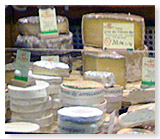
Is it easier in America to buy a gun than French cheese?


View Comments | Reddit | Tumblr | Digg | FARK
Yes.  But.

The following graphic has been making its way around the Internet this weekend.

I was intrigued, but suspicious. I don't like to send things around, or post them on the blog, if something doesn't smell right (no pun intended, as we are talking about wonderfully stinky French cheese). So I did a little digging, and here's what I found.

The graphic is kinda right.

J'accuse!
It seems that, of all things, an outbreak of Typhoid in Canada in the early 1940s was linked to Cheddar cheese made from raw milk (call her, Typhoid Elsie). Fast forward to 1950, and the FDA decides to do something about the dangers of stinky French cheese, and bans the sale of any imported cheese from raw milk that is not aged for a minimum of 60 days (a ban on domestically-produced cheese was, reportedly, instituted a few years before that).  The thinking was/is that the curing process kills the bacteria (and recent research suggests that even that may not always work).

And so began America's cheese panic.

So, the cheeses in the graphic are not banned per se.  They're only banned if they're made with raw milk that hasn't been aged a minimum of 60 days.  And if they're made with pasteurized milk, they're fine.  Thus, newer French Brie cheese made with pasteurized milk can be sold in the US (even though it's reportedly less tasty than the "real" French version - and part of the lost flavor of some French cheeses comes from the fact that their peak flavor comes at a time "less" than 60 days).  Sadly, there's a section of the site I link that appears to note some exceptions to the rule, but the section isn't written in complete sentences, so it makes no sense.  So I did some more research...

What I found was that there seems to be another restriction, beyond the 60 day rule. This from an article in 2005:
According to John Sheehan of the FDA's Center for Food Safety and Applied Nutrition, in the 1980s both countries agreed that all soft cheeses from France would be made from pasteurized milk in plants certified by the French government. This followed the detection of the harmful listeria bacteria in some French Brie.
2005 was around the same time that the FDA cracked down on French cheese entering the US - previously they apparently had overlooked some of the "illegal" cheeses. Now they were cracking down even on some cheese aged over 60 days - possibly for legit reasons, possibly as retaliation for a trade dispute.

And there's talk of banning raw milk cheese all together:
But in recent months, two recalls involving e. coli in raw-milk cheese have brought that law into question: in November, at Bravo Farms, near Fresno, then in December, at Sally Jackson Cheese, in Washington State.

David Acheson, a former associate commissioner for the U.S. Food and Drug Administration, says laboratory tests have suggested that e.coli O157, and possibly other microbes, as well, can survive the 60-day aging process.

“There’s real concern that the 60 days isn’t long enough,” he says.

On average, there are about 40 reported cases a year of people getting sick from raw-milk cheese, nationwide, according to the Centers for Disease Control. During a 15-year period between 1993 and 2008, two people died from those illnesses.

That's a small fraction of the outbreaks that have been traced back to ground beef, for example, and the number has stayed fairly constant. Still, the FDA says raw-milk cheese is a growing concern.
Two people died over fifteen years from eating raw milk cheese.  Significantly more died over that period from guns, about 450,000 people (that includes suicides, but hey, we don't let people intentionally kill themselves by eating French cheese, so why allow guns?).

In the end, I couldn't confirm that any of the cheeses listed in the graphic above are actually "banned" in the US, because there are versions of them - with pasteurized milk or aged over 60 days - that are permitted for several of them (I didn't check them all).  The graphic indicates, for example, that French roquefort (i.e., blue cheese) is not permitted into the US.  That's not true.  You can buy the French "President" brand blue cheese in the US - I  have.  The same goes for the graphic's mention of Camembert.  Obviously, the American versions are either pasteurized or aged over 60-days.

Now, the graphic would be correct if it got a little more specific and, say, added an asterisk noting that the original, "true," raw-milk-aged-under-60-day versions of these French cheeses are banned in the US.  Try this:


And that's our food science lesson for the day.  At least this explains why I have such a hard time finding a good tangy French chèvre at the market in the states. Read the rest of this post...
Why diet soda makes you fat


View Comments | Reddit | Tumblr | Digg | FARK
There have been some interesting studies in the past showing the rise of obesity increasing at the same time as "diet" or "lite" food products gaining popularity. It would not be much of a surprise if the diet food industry knew of this problem years ago, but at least us on the outside know more now.

Eat this stuff at your own risk.
Consuming high amounts of fructose (a type of sugar), artificial sweeteners, and sugar alcohols (another type of low-calorie sweetener) cause your gut bacteria to adapt in a way that interferes with your satiety signals and metabolism, according to a new paper in Obesity Reviews. (If you've noticed you've been feeling tired all the time and gaining weight, your metabolism may be slowing.)

"An evolution of the gut flora to this new sweetener-rich environment has a potential to negatively impact our health," says Amanda Payne, Ph.D., lead author of the review.

How does that happen? As bacteria in the gut process food, they give off byproducts called short-chain fatty acids. These can be beneficial and serve as energy in the body. But as the sweetener-adapted bacteria thrive and become more efficient at processing large amounts of high-fructose corn syrup, artificial sweeteners, and sugar alcohols, they also produce more and more short-chain fatty acids. (Not to imply that sugar is any better than artificial sweeteners.)

In those high amounts, Payne says, short-chain fatty acids decrease satiety signals. "This signaling may cause disruptions in our feeling full and hence prevent us from stopping to eat when we should," Payne says.
Read the rest of this post...

Senate votes 73–26 to deny states the right to label GMO foods (Or, Meet your Monsanto Senators)


View Comments | Reddit | Tumblr | Digg | FARK
The headline tells it all, but there's an excellent piece by Howie Klein at Down With Tyranny on this news — "Genetically Modified America" — that's well worth a read. Do go there for more. A taste:
Last week the House Agriculture Committee-- basically a bipartisan arm of Agribusiness whose members are handsomely bribed to trample on consumer interests-- voted in favor of Frankenfoods....
Not hard to get Howie's drift.

Here I'd like to do the Dems thing, and talk about the actual votes — who did what.

This is the Senate amendment (my emphasis):
Question: On the Amendment (Sanders Amdt. No. 2310)

Amendment Number: S.Amdt. 2310 to S. 3240 (Agriculture Reform, Food, and Jobs Act of 2012)

Statement of Purpose: To permit States to require that any food, beverage, or other edible product offered for sale have a label on indicating that the food, beverage, or other edible product contains a genetically engineered ingredient.
Note that this isn't a federal labeling requirement. It simply allows states to decide labeling for themselves.

The amendment failed, 26–73. These are your Monsanto senators:
NAYs ---73
Alexander (R-TN)
Ayotte (R-NH)
Barrasso (R-WY)
Baucus (D-MT)
Bingaman (D-NM)
Blunt (R-MO)
Boozman (R-AR)
Brown (D-OH)
Brown (R-MA)
Burr (R-NC)
Carper (D-DE)
Casey (D-PA)
Chambliss (R-GA)
Coats (R-IN)
Coburn (R-OK)
Cochran (R-MS)
Collins (R-ME)
Conrad (D-ND)
Coons (D-DE)
Corker (R-TN)
Cornyn (R-TX)
Crapo (R-ID)
DeMint (R-SC)
Durbin (D-IL)
Enzi (R-WY)
Franken (D-MN)
Gillibrand (D-NY)
Graham (R-SC)
Grassley (R-IA)
Hagan (D-NC)
Harkin (D-IA)
Hatch (R-UT)
Heller (R-NV)
Hoeven (R-ND)
Hutchison (R-TX)
Inhofe (R-OK)
Isakson (R-GA)
Johanns (R-NE)
Johnson (R-WI)
Klobuchar (D-MN)
Kohl (D-WI)
Kyl (R-AZ)
Landrieu (D-LA)
Lee (R-UT)
Levin (D-MI)
Lugar (R-IN)
McCain (R-AZ)
McCaskill (D-MO)
McConnell (R-KY)
Menendez (D-NJ)
Moran (R-KS)
Nelson (D-FL)
Nelson (D-NE)
Paul (R-KY)
Portman (R-OH)
Pryor (D-AR)
Reid (D-NV)
Risch (R-ID)
Roberts (R-KS)
Rubio (R-FL)
Schumer (D-NY)
Sessions (R-AL)
Shaheen (D-NH)
Shelby (R-AL)
Snowe (R-ME)
Stabenow (D-MI)
Thune (R-SD)
Toomey (R-PA)
Udall (D-CO)
Vitter (R-LA)
Warner (D-VA)
Webb (D-VA)
Wicker (R-MS)
Your Monsanto senators in action:
  • Al Franken (202-224-5641)
  • Sherrod Brown (202-224-2315)
  • Dick Durbin (202-224-2152)
  • Tom Harkin (202-224-3254)
  • Amy Klobushar (202-224-3244)
  • Debbie Stabenow (202-224-4822) 
Six of many ... forces for good on a mountain of evil.

Except for Gillibrand, these folks voted to keep $4.5 billion out of the school lunch program — and all were PIPA supporters or co-sponsors as well.

Evil must be rubbing off.

UPDATE: Looks like we have a Monsanto President. Commenter ezpz has the goods, here and here and here.

And here's the link to CREDO Action to fire Monsanto lobbyist Michael Taylor as Obama's "Food Safety Czar." Who are these people?

GP

To follow or send links: @Gaius_Publius
  Read the rest of this post...

23 Senate Dems vote against restoring $4.5 billion in Food Stamp aid


View Comments | Reddit | Tumblr | Digg | FARK
Your "progressive" Democratic senators at work.

Here's the amendment mentioned in the title (kudos to Kirsten Gillibrand for pushing it):
Amendment Number: S.Amdt. 2156 to S. 3240 (Agriculture Reform, Food, and Jobs Act of 2012)

Statement of Purpose: To strike a reduction in the supplemental nutrition assistance program and increase funding for the fresh fruit and vegetable program, with an offset that limits crop insurance reimbursements to providers.
Here's the vote (note that it failed):
Vote Counts:
YEAs 33
NAYs 66
Not Voting 1
And here are the Senate Democrats voting NO (I've bolded the "special" ones):
NAYs ---66
Alexander (R-TN)
Ayotte (R-NH)
Barrasso (R-WY)
Baucus (D-MT)
Bennet (D-CO)
Bingaman (D-NM)
Blunt (R-MO)
Boozman (R-AR)
Burr (R-NC)
Carper (D-DE)
Chambliss (R-GA)
Coats (R-IN)
Coburn (R-OK)
Cochran (R-MS)
Collins (R-ME)
Conrad (D-ND)
Corker (R-TN)
Cornyn (R-TX)
Crapo (R-ID)
DeMint (R-SC)
Durbin (D-IL)
Enzi (R-WY)
Franken (D-MN) [!!]
Graham (R-SC)
Grassley (R-IA)
Hagan (D-NC)
Harkin (D-IA)
Hatch (R-UT)
Hoeven (R-ND)
Hutchison (R-TX)
Inhofe (R-OK)
Inouye (D-HI)
Isakson (R-GA)
Johanns (R-NE)
Johnson (D-SD)
Johnson (R-WI)
Klobuchar (D-MN)
Kohl (D-WI)
Kyl (R-AZ)
Landrieu (D-LA)
Lee (R-UT)
Lugar (R-IN)
Manchin (D-WV)
McCain (R-AZ)
McCaskill (D-MO)
McConnell (R-KY)
Moran (R-KS)
Nelson (D-FL)
Nelson (D-NE)
Paul (R-KY)
Portman (R-OH)
Pryor (D-AR)
Risch (R-ID)
Roberts (R-KS)
Rubio (R-FL)
Sessions (R-AL)
Shelby (R-AL)
Stabenow (D-MI)
Tester (D-MT)
Thune (R-SD)
Toomey (R-PA)
Udall (D-CO)
Vitter (R-LA)
Warner (D-VA)
Webb (D-VA)
Wicker (R-MS)
I count 23 Democrats in that list. Let's see, 23 + 33 (carry the 0) ... golly. That's enough Democrats to pass the thing.

Some pure speculation:

■ Why did it fail? Maybe because of the offset?
... with an offset that limits crop insurance reimbursements to providers.
High-dollar agribusiness farms can't eat on no money. Can't have that.

■ Why did so many Midwest "progressive" senators vote No?

Let's imagine, you and I. We're in the Senate, we're voting on a bill no one is watching, so it's a freebie.

It's going to lose anyway (that's why the Party has Ben Nelson & Ilk in it — to do the dirty work), so why not just suck up to our past and future campaign contributors and vote No? After all, we can't keep on doing this great work of conscience without them.

But you and I, we're not pure of heart like our "progressive" senators. They're like the falling snow. White. Opaque. Cold. With their hands out. That's why we vote for them.

Food stamps. Children. Conscienceless, say I. Your "progressive" Democratic senators at work.

UPDATE: More here. And here.

GP

To follow or send links: @Gaius_Publius Read the rest of this post...

Survey by The Guardian shows extreme hunger in UK schools


View Comments | Reddit | Tumblr | Digg | FARK
Everything about this new survey is disturbing. Reading it takes me back to the early days of nastiness in America, when Reagan and the GOP wanted to declare catsup as a vegetable. The mean spirited "me first" attitude of those early days is nothing compared to what they churn out today, but it raises questions about the direction of things in the UK.

Though not perfect, the UK has generally been a much more tolerant country than the modern US. The extreme hatred that so strongly dominates the US ("religious") right has still been mostly absent in the UK, with a few exceptions.

Is the Tory government now tapping in to existing sentiment or are they promoting American right wing selfishness? It could be some of both, but whichever it is, the direction is not good. There's something fundamentally wrong when school teachers are seeing such extreme problems with hunger in the classroom.

How bad will things be when the full impact of the Tory budget chopping hits the country?
Four out of five teachers (83%) see pupils who are hungry in the morning and 55% said up to a quarter of pupils arrive having not eaten enough. More than half say the number of children involved has been rising in the past year or two, which have seen some families hit hard by the recession, unemployment and benefit cuts.

In the survey of 591 teachers across Britain who belong to the online Guardian Teacher Network, 49% said they have taken food or fruit into school to give to children who have not had breakfast. Almost one in five (17%) have given such pupils money out of their own pockets to buy lunch.

Almost four in five (78%) said they wanted children from low-income families to get a free breakfast on arrival at school, just as some already receive a free lunch.
Read the rest of this post...

Young food blogger wins the day


View Comments | Reddit | Tumblr | Digg | FARK
It's hard not to get a smile when you read about someone beating the odds and winning like this. Martha Payne is the 9 year old kid who blogged about the unhealthy food her school was serving, only to be shut down by the school. Not only did the outrage push the school to let her blog again about the food, but the story also led to a celebrity chef joining her to help create a new menu for the school. How fun is that?
When a 9-year-old Scottish girl started her popular blog in April, all she was looking to do was document the quality of food choices at her school and raise some money for charity. One controversy later, Martha Payne is now helping to choose the school’s lunches with a celebrity chef and has generated more than $120,000 for a charity that is building an African school kitchen.

Martha became a worldwide trending topic on Twitter Friday after she posted on Thursday that the local Argyll and Bute Council banned her from publishing photos of her school lunches on her blog. The council then pulled a 180 and gave her permission to continue blogging after the ensuing outcry on social media. Three days later, it was announced that she is teaming up with celebrity chef Nick Nairn to help the council provide more nutritious meals at her school, Lochgilphead Primary in Argyll.
Read the rest of this post...

9 year old food blogger shut down by politicians


View Comments | Reddit | Tumblr | Digg | FARK
Great values that are being taught by those in power. Who really wants a 9 year old kid doing something to help school kids eat well and then donate money to feed poor kids in Africa? How outrageous, right?

If the political class doesn't like being embarrassed by the terrible food that they're serving kids, they should fix the system rather than ban a kid from stepping up and trying to improve the system. Read the sad story at Wired. Read the rest of this post...

Iowa, South Dakota & Nebraska still serving Pink Slime at schools


View Comments | Reddit | Tumblr | Digg | FARK
They could easily opt out of serving the disgusting excuse for food but they don't. What parent wants their kid eating that garbage?
All but three states have opted out of ordering the controversial beef product famously dubbed "pink slime" for their school lunch programs says the United States Department of Agriculture (USDA). Iowa, South Dakota, and Nebraska will continue to buy ground beef with added lean finely textured beef (LFTB), ammonia-treated scraps that are used as filler.

The term “pink slime” was coined by former USDA scientist Gerald Zirnstein and used in a 2009 interview by the New York Times on the safety of beef processing. In 2011, the product was featured on a segment of Jamie Oliver’s Food Revolution.
But hey, the parents got their precious tax cuts, right? Isn't that all that matters? Read the rest of this post...

FDA rejects "corn sugar" name for high fructose corn syrup


View Comments | Reddit | Tumblr | Digg | FARK
It's a fair ruling since corn syrup is just corn syrup, but how did such a well financed lobby lose? The FDA is not known for being strong in the face of a well funded industry. Whatever happened should be reviewed so it can be repeated elsewhere.
The Food and Drug Administration on Wednesday rejected the Corn Refiners Association's bid to rename its sweetening agent "corn sugar."

Given the sweetener's bad reputation in recent years, the association submitted an application to the agency in 2010 to have the product renamed on nutrition labels.

But the FDA said that it defines sugar as a solid, dried and crystallized food — not a syrup.
What's amusing in this case is that the corn syrup lobby has been trying to sell their product as something as good as processed white sugar, as if that is a healthy product. Read the rest of this post...

Pacific tuna carried radioactivity from Japan to US coast


View Comments | Reddit | Tumblr | Digg | FARK
There were plenty of reports of higher than usual levels of radiation in fruits, vegetables and milk in California last year but this is something much different. While I wouldn't want to go out of my way to eat California produce for a while, eating a Pacific tuna sounds much less appealing for the time being.

Officials says that despite the radiation level being 10 times the normal level, they're still safe to eat, but for me I would not want to take that risk when there are enough other choices out there. In theory (according to scientists) the tuna shed the dangerous radiation over time though I would still err on the side of caution until the levels have settled.

The ocean food chain in action.
Across the vast Pacific, the mighty bluefin tuna carried radioactive contamination that leaked from Japan's crippled nuclear plant to the shores of the United States 6,000 miles away — the first time a huge migrating fish has been shown to carry radioactivity such a distance.

"We were frankly kind of startled," said Nicholas Fisher, one of the researchers reporting the findings online Monday in the Proceedings of the National Academy of Sciences.

The levels of radioactive cesium were 10 times higher than the amount measured in tuna off the California coast in previous years. But even so, that's still far below safe-to-eat limits set by the U.S. and Japanese governments.
Read the rest of this post...